The Tokenisation Engine transforms verified legal-economic rights into controlled digital instrument states—without pretending code creates rights on its own.
The rights schedule defines economic priority, distributions, governance rights, lock-ups, transfer limits, redemption rules, risk factors and dispute resolution. The engine stores a cryptographic reference so issuance remains tied to the governing documents.
Creation, issuance, lock, transfer, pledge, distribution, redemption and cancellation are treated as deterministic state transitions. Supply cannot exceed authorised economics without a documented amendment.
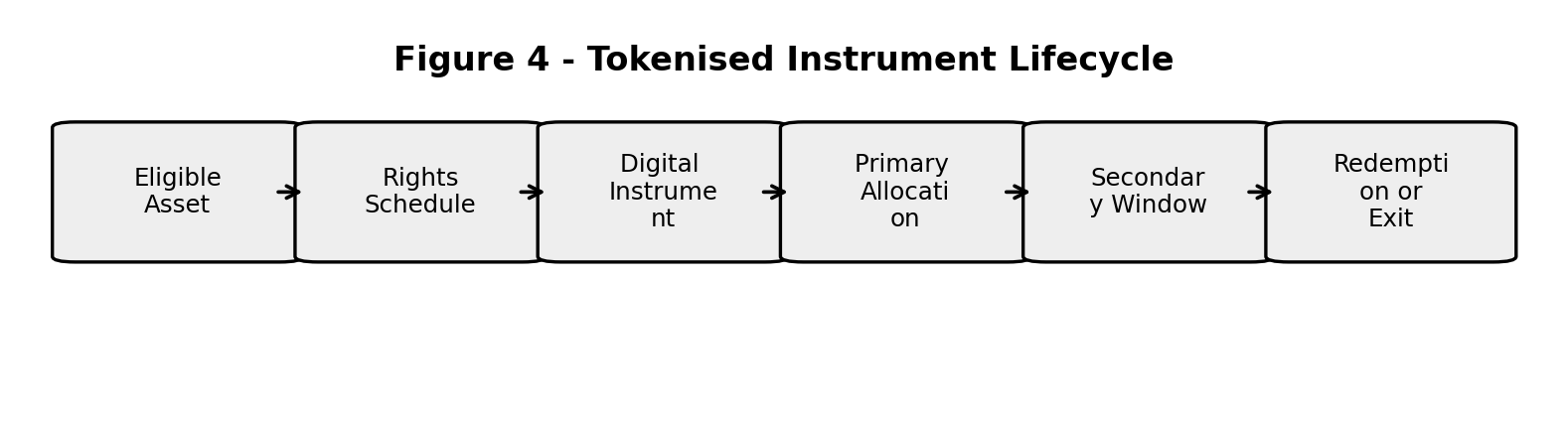
Recipient accounts or wallets can require KYC/AML, investor-category and product eligibility before transfer.
Instrument rules can apply geographic restrictions, minimum holding periods and concentration limits.
Outstanding digital units remain bounded by the economic interest authorised by the legal vehicle.
The underlying project, cash flow, turnaround plan, financing need or operating business remains the investment. Digital instruments improve administration, cap-table clarity, reporting, transfer control and settlement.
| PE stage | Traditional process | Protocol equivalent |
|---|---|---|
| Origination | Sponsor prepares investment thesis. | Asset enters verification with metadata, evidence and risk tags. |
| Due diligence | Legal, financial and technical review. | Status is linked to permissioned evidence and issuance conditions. |
| Structuring | SPV and rights documents are drafted. | Rights schedule maps to digital instrument parameters. |
| Capital call | Investors subscribe and wire funds. | Payment proof and registry allocation run through settlement workflow. |
| Exit | Sale, refinance or distribution. | Instrument is redeemed, transferred, settled or cancelled under exit rules. |